

Is France witnessing the beginnings of a Christian spiritual awakening—or a deeper struggle over the future of European civilization?

🎉📖Discover Pastor Paul Begley and Troy Anderson’s Inspiring Book Collection🎉📖
Revelation Watchers is a reader-supported publication. If you enjoy our articles and Pastor Paul Begley’s The Coming Apocalypse and Troy Anderson’s Revelation Watchers shows, consider becoming a paid subscriber. You will receive access to read in-depth articles, watch exclusive interviews, and partner in our mission to spread the Good News of Jesus Christ.
From the shattered biblical kings of Notre-Dame to today’s struggles over faith, national identity, and political power, France’s turbulent history raises a profound question: Can a civilization rediscover its spiritual foundations before they are lost?
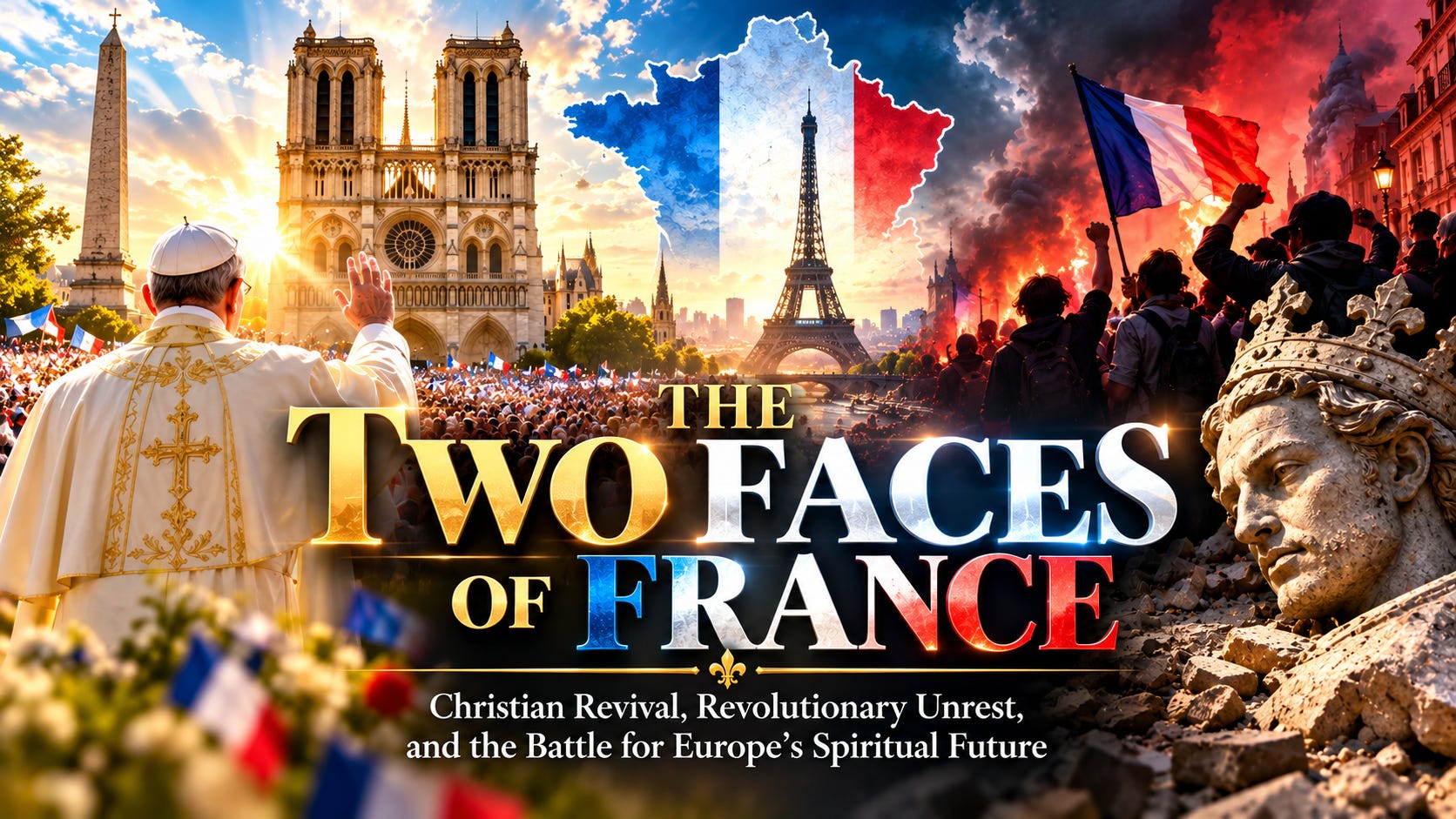
On September 26, 2026, an extraordinary scene unfolded in the heart of one of Europe’s most secular nations. An estimated 800,000 people gathered along the Champs-Élysées and around Place de la Concorde as Pope Leo XIV celebrated an outdoor Mass, filling the historic streets of Paris with prayers, hymns, and a remarkable public expression of Christian faith.
For a nation whose revolutionary history includes the dismantling of religious institutions and the destruction of sacred symbols, the gathering offered a striking reminder that Christianity remains deeply woven into France’s cultural and spiritual identity. The Pope’s message emphasized humanity’s longing for God, spiritual renewal, and the enduring importance of faith in a fractured world.
Yet within days, another dramatically different scene was unfolding across the country.
Students marched through Paris, Marseille, Lyon, and other cities, protesting deteriorating schools, teacher shortages, overcrowded classrooms, and mounting uncertainty about their future. Although many demonstrations remained peaceful, some were marked by vandalism, attacks on educators, burning barricades, and confrontations between protesters and police. Reports of injuries and controversial police tactics further intensified public anger.
The contrast attracted the attention of American broadcaster Glenn Beck, who suggested that France’s contemporary tensions reflect a struggle extending back more than two centuries—a conflict between the nation’s Christian inheritance and revolutionary traditions that challenged established political and religious authority.
But beneath the headlines lies a deeper historical story, one that reaches back to the French Revolution, the destruction of the biblical kings adorning Notre-Dame Cathedral, and the extraordinary survival of a religious heritage that has endured revolution, war, secularization, and profound social transformation.
For Christians examining world events through the lens of the Bible, these developments also raise questions about spiritual renewal, earthly power, and the importance of discernment in an increasingly uncertain world.
Two Faces of France: Faith and Unrest
The September 26 Mass represented one of the most visible expressions of Christian faith in recent French public life. According to the Vatican, approximately 800,000 people attended the celebration, with crowds stretching from Place de la Concorde along the Champs-Élysées toward the Arc de Triomphe. The gathering included practicing Catholics, younger worshippers, political figures, and visitors drawn by the historic occasion.
In his homily, Pope Leo XIV spoke of humanity’s spiritual thirst and described Christ as the source of living water capable of satisfying the deepest longings of the human heart. He encouraged French Catholics to share their faith through lives of service, compassion, and witness, while acknowledging the country’s long Christian history.
The gathering was especially significant in a nation where the principle of laïcité, or secularism, has shaped public institutions and the relationship between religion and government for generations. France’s secular constitutional tradition protects freedom of conscience while maintaining the separation of religious institutions from the state. Yet secular government does not necessarily mean the disappearance of religious belief, and the Paris gathering demonstrated that Christianity continues to command a substantial public presence.
Indeed, Pope Leo subsequently pointed to growing interest in baptism among young people and adults as an encouraging development within the French Church. Such signs do not establish a nationwide religious revival, but they complicate the familiar narrative that Christianity’s influence in Western Europe is destined only to decline.
At nearly the same moment, however, another national movement was gaining momentum.
Beginning in September, students and education workers organized demonstrations against deteriorating educational conditions, inadequate staffing, and concerns about the future facing younger generations. By early October, the protests had spread across France, transforming local grievances into a national debate over public investment, institutional accountability, and the government’s economic priorities.
On October 8, Reuters reported that 71,500 people participated in demonstrations nationwide, including 24,500 in Paris, according to the Interior Ministry. While the principal Paris demonstration was largely peaceful, authorities reported incidents elsewhere involving vandalized school facilities, attacks on teachers, and violence against public property. Police responses also generated controversy, particularly following serious injuries to young demonstrators.
The movement continued into the following week. On October 13, the Interior Ministry estimated that approximately 161,500 people had joined another wave of demonstrations, while student organizers reported substantially higher participation.
Behind the unrest lies a difficult national dilemma. France faces substantial public debt, budgetary constraints, and competing demands for government spending, even as citizens call for improvements in education and other essential services. The demonstrations have exposed a widening gap between younger generations’ expectations and their confidence in the institutions responsible for preparing them for the future.
These protests cannot fairly be reduced to a rejection of Christianity or French civilization. Many participants are motivated by legitimate concerns about education, opportunity, and public services, and their demands must be distinguished from violence committed by individual demonstrators.
Nevertheless, the juxtaposition of enormous religious gatherings and nationwide political unrest presents two striking expressions of a society searching for answers—one drawing upon spiritual tradition, the other demanding institutional change. Together, they illuminate a country confronting difficult questions about its identity, values, and future.

Get Trump vs. the Beast Today →
Now available in hardcover, e-book and audiobook.
Amazon | Barnes & Noble | | Books-A-Million
Glenn Beck’s Warning: A Nation Divided Against Itself
In a recent commentary, Glenn Beck drew a dramatic parallel between contemporary France and the revolutionary upheavals that transformed the country during the late eighteenth century. His central argument was that France’s current tensions reflect more than temporary political dissatisfaction; they reveal a longstanding struggle between competing interpretations of the nation’s historical and cultural identity.
One vision emphasizes France’s Christian inheritance, its magnificent cathedrals, centuries-old religious traditions, and the faith that influenced much of European civilization. The other, in Beck’s interpretation, draws from revolutionary movements that challenged inherited structures of authority and sought to redefine the relationship between the individual, religion, and the state.
For Beck, the contrast between public Christian worship and scenes of unrest symbolizes a deeper conflict over France’s future. He traces that struggle to the French Revolution, when revolutionary factions sought not only to overthrow the monarchy but also to transform the nation’s religious and political foundations.
The comparison is provocative, but it requires historical care. Modern student demonstrations are not direct equivalents of the French Revolution, nor is contemporary France simply divided between Christianity and revolutionary ideology. The Revolution itself involved complex disputes over political representation, taxation, inequality, religious authority, and the meaning of liberty. Its legacy includes both the expansion of modern ideas about citizenship and episodes of severe political repression and religious persecution.
Nevertheless, Beck’s commentary highlights a genuine historical paradox. France is simultaneously the homeland of medieval cathedrals, Christian saints, theological scholarship, and centuries of Catholic influence—and a nation whose revolutionary traditions profoundly reshaped the relationship between religion, government, and civic identity.
Nowhere is that tension more vividly preserved than in the stones of Notre-Dame Cathedral, where one of the French Revolution’s most remarkable acts of destruction left a legacy that would remain hidden beneath Paris for nearly two centuries.

AMERICA’S FUTURE. A PROPHECY UNFOLDING?
Discover the #1 Amazon bestseller The Trump Code, Troy Anderson’s compelling investigation into biblical prophecy, extraordinary historical connections, and the forces shaping America’s destiny. | Get Your Copy on Amazon →
The Beheaded Kings of Notre-Dame: A Warning from History
In 1793, at the height of the French Revolution, an extraordinary act of destruction unfolded at Notre-Dame Cathedral. High above its western entrance stood a gallery of 28 crowned figures, carved in stone and overlooking the streets of medieval Paris. To revolutionary crowds, the statues appeared to represent the kings of France, whose monarchy had been overthrown and whose symbols of authority they were determined to dismantle.
But the revolutionaries had made a profound mistake.
The figures did not depict the kings of France. They represented the biblical kings of Judah, associated with the ancestral lineage of Jesus Christ. Mistaking them for symbols of the fallen monarchy, revolutionary authorities ordered the sculptures removed from the cathedral’s façade. Their heads were severed and their bodies broken apart in an episode of iconoclasm that reflected the determination to dismantle visible symbols of the old political and religious order.
The campaign extended beyond the statues themselves. During the revolutionary movement to reduce Christianity’s influence on French public life, Notre-Dame was stripped of much of its traditional religious function. In November 1793, the cathedral became the setting for celebrations associated with the Cult of Reason, which sought to elevate revolutionary civic and philosophical ideals in place of established religious authority.
For a time, one of Europe’s most celebrated Christian sanctuaries became a symbol of the effort to transform not only France’s government, but also its relationship with faith, history, and sacred tradition.
Yet the story of Notre-Dame’s biblical kings did not end with their destruction.
Nearly two centuries later, in 1977, workers excavating the courtyard of the Hôtel Moreau in Paris made a remarkable discovery. Beneath the ground lay medieval stone fragments, including 21 heads from the cathedral’s long-lost Gallery of Kings. The sculptures had survived underground for approximately 184 years, preserved through political upheavals, wars, and profound social transformations.
Today, these extraordinary remnants are housed at the Musée de Cluny, France’s National Museum of the Middle Ages, where visitors can encounter the faces of figures once condemned to destruction.
Their rediscovery offers a powerful historical image of endurance. The revolutionaries could tear down the statues, shatter their crowns, and transform the cathedral into a monument to a new political order, but they could not entirely erase the religious and cultural history those figures represented. What one generation sought to destroy, another would eventually recover.
For Christians reflecting on the endurance of faith through centuries of upheaval, the story also carries spiritual symbolism. Religious institutions may be challenged, sacred buildings damaged, and political movements determined to redefine a nation’s identity, yet the beliefs and historical memories associated with those institutions can endure beyond the governments and ideologies that seek to replace them.
The history of France itself reinforces that distinction. The Revolution profoundly disrupted Catholic life, but it did not permanently eliminate Christianity from the nation. In 1801, Napoleon Bonaparte reached an agreement with Pope Pius VII known as the Concordat, which helped restore formal relations between the French government and the Catholic Church and provided a framework for renewed public worship.
The arrangement recognized Catholicism as the religion of the great majority of French citizens while preserving important changes introduced during the Revolution. It did not restore the old monarchy or return France to its prerevolutionary religious order. Instead, it reflected a political acknowledgment that religious belief remained deeply embedded in French society.
The historical lesson extends beyond Napoleon’s political calculations. Even sweeping revolutions do not necessarily extinguish spiritual traditions that have shaped a civilization over centuries. Yet the survival of churches, religious institutions, and sacred architecture does not guarantee that faith will remain vibrant across successive generations. That depends, in part, on families, congregations, educators, and communities willing to transmit their convictions.
The buried kings of Notre-Dame do not establish that France is entering a new Christian revival. Their survival nevertheless reminds us that a civilization’s spiritual inheritance may remain part of its collective memory even after generations of political and cultural transformation.
BIBLICAL PROPHECY MEETS TODAY’S HEADLINES.
In the #1 bestseller Revelation 911, Pastor Paul Begley and Troy Anderson explore how the ancient prophecies of Revelation intersect with today’s wars, global upheaval, emerging technologies and rapidly changing world events—calling believers to watch, pray and remain spiritually prepared.
Friedrich von Schiller: The Power of Ideas—and the Different Paths of Revolution
For myself (investigative journalist and bestselling author Troy Anderson), the French Revolution carries a personal literary connection. As I recount on my official website, my grandmother, Trella Hope Schiller, encouraged me to follow in the footsteps of my great-grandfather-plus Friedrich von Schiller (1759–1805), the celebrated German poet and playwright whom Ranker.com lists as the 134th greatest writer of all time. His writings championed liberty, human dignity, and resistance to tyranny—ideals that helped shape my own literary journey.
Schiller’s groundbreaking drama The Robbers challenged arbitrary authority, while Don Carlos explored freedom of conscience. In 1792, revolutionary France honored him with honorary citizenship. Yet as the Revolution descended into the Reign of Terror, Schiller grew troubled by the violence carried out in liberty’s name. His later writings emphasized that genuine freedom requires moral character, education, and respect for human dignity.
The American and French Revolutions emerged from overlapping Enlightenment ideals but followed different historical paths. Schiller’s experience offers an enduring lesson: Ideas can inspire revolutions, but the moral choices of those who embrace them help determine whether the pursuit of freedom leads toward renewal—or destruction.
Discover how Schiller’s remarkable literary legacy inspired Troy Anderson’s journey as an investigative journalist and bestselling author.
Read Troy Anderson’s Personal Story: Friedrich von Schiller →
The Battle Over France’s Political Future
France’s present unrest is unfolding against the backdrop of another consequential turning point: the presidential election scheduled for 2027. With President Emmanuel Macron’s second term approaching its conclusion, the country faces contentious debates over economic priorities, national sovereignty, public services, immigration, and the institutions that have long defined the French republic.
Among the prominent figures shaping these debates is Jean-Luc Mélenchon, the veteran left-wing leader associated with La France insoumise, or France Unbowed. Mélenchon has praised the student protest movement and criticized police responses, aligning himself with demonstrators demanding improvements to France’s educational system. Government officials, meanwhile, have accused some political leaders of exploiting or inflaming public anger. Such allegations remain politically contested, and support for peaceful demonstrations does not establish responsibility for violence committed by individual participants.
On the nationalist right, Marine Le Pen and her political allies have emphasized public order, immigration controls, national sovereignty, and concerns about France’s cultural direction. Their political arguments reflect a different interpretation of the country’s challenges, placing greater emphasis on security, integration, and the authority of the state.
Immigration and the role of Islam in French society remain particularly sensitive subjects within this broader national debate. France is home to a substantial and diverse Muslim population, and disagreements over religious expression, integration, and secularism have influenced public discourse for decades. Yet these questions cannot responsibly be reduced to the assumption that an entire religious community shares a single political agenda. France’s tradition of laïcité also protects freedom of conscience, even as citizens disagree over how secular principles should apply in schools, public institutions, and daily life.
The approaching election has intensified discussion about what it means to belong to the French republic and which institutions should unite its citizens. Economic uncertainty, dissatisfaction with public services, and political polarization have complicated efforts to build consensus across ideological and cultural divisions.
Ultimately, the challenge extends beyond any single politician, political party, religion, or election. It concerns the capacity of a diverse democratic society to maintain public trust, preserve religious freedom, uphold the rule of law, and sustain a shared civic identity amid profound disagreements about its future.
France’s historical experience offers a reminder that political transformation can reshape institutions, but the deeper questions of identity, belonging, and moral responsibility cannot be settled by electoral competition alone.
DISCOVER I’VE BEEN TO HEAVEN | An extraordinary true story of a near-death experience, the power of prayer, and the hope of Heaven. This ECPA Bestseller and AWSA Memoir of the Year, written with Troy Anderson, shares Steve and Kathy Boyls’ inspiring testimony of faith, miracles, and God’s love.
A Spiritual Awakening—or a Deeper Struggle?
For Christians observing the contrasting developments in France, the images of public worship, political demonstrations, and growing social divisions invite reflection on a broader question: What happens when a society’s inherited religious traditions no longer provide the same common framework for understanding identity, morality, and public life?
Across Europe, declining church attendance, changing patterns of religious affiliation, and the growing influence of secular institutions have prompted debate about Christianity’s future. Some observers regard these developments as part of the evolution of modern pluralistic democracies, where religious belief becomes increasingly a matter of personal conviction rather than inherited cultural identity. Others worry that the weakening of longstanding traditions may diminish a sense of shared purpose, leaving communities searching for new sources of meaning and belonging.
The emerging picture, however, is not uniform. Some Christian communities report renewed interest among younger adults, including growing participation in religious instruction, baptismal preparation, and spiritual exploration. Other congregations continue to experience declining attendance, aging memberships, and diminishing institutional influence. Europe’s religious future cannot be adequately described by a single narrative of either inevitable secular decline or an emerging continent-wide revival.
The relationship between secularization and social instability is also more complex than any single theological or historical explanation can capture. Economic inequality, political polarization, demographic change, institutional distrust, and the pressures facing younger generations all contribute to contemporary unrest. The student demonstrations in France, for example, have identifiable educational and economic grievances that should not be obscured by attempts to interpret them exclusively as a spiritual conflict.
For Christian believers, these distinctions raise an important question about the meaning of authentic revival. Large gatherings, historic ceremonies, and renewed public interest in Christianity may be encouraging, but they do not necessarily demonstrate lasting transformation. Genuine spiritual renewal would be reflected in sustained personal commitment, strengthened families and communities, acts of compassion and service, and a willingness to live according to the teachings of Christ.
The Apostle Paul expressed the importance of inward transformation in Romans 12:2:
“And be not conformed to this world: but be ye transformed by the renewing of your mind.” — Romans 12:2 (KJV)
For believers reflecting on France’s turbulent history, the passage offers a reminder that authentic Christian renewal begins not with political dominance, national prestige, or the preservation of magnificent religious monuments, but with the transformation of individual hearts and minds. Europe’s cathedrals testify to centuries of Christian artistic achievement and religious devotion, yet their continued existence cannot substitute for the living faith they were built to express.
Meanwhile, Europe’s political and cultural future is being shaped by transformations extending far beyond religion. Debates over migration, national sovereignty, artificial intelligence, digital surveillance, economic uncertainty, and democratic governance are challenging longstanding assumptions about the relationship between citizens and the state. These developments do not necessarily point toward a single predetermined political or prophetic outcome, but they suggest that questions of identity, meaning, moral responsibility, and spiritual belonging will remain important.
For Christians, the appropriate response is neither indifference nor the assumption that every international crisis signals the immediate fulfillment of biblical prophecy. Faithful watchfulness requires careful examination of events, humility in interpreting Scripture, prayer for wisdom, and constructive participation in society.
Jesus’ warning in Matthew 24:4 remains especially relevant:
“Take heed that no man deceive you.” — Matthew 24:4 (KJV)
In an era of rapidly circulating information and competing claims about the future, discernment requires both spiritual seriousness and a commitment to truth. It means examining Scripture in context, testing extraordinary claims against reliable evidence, and distinguishing genuine developments from speculation.
If Europe is entering a new spiritual chapter, its significance will ultimately be reflected not simply in political upheaval or extraordinary public gatherings, but in the enduring choices of individuals and communities seeking faith, purpose, and truth in a changing world.
Unlock the mystery of biblical prophecy.
The Babylon Code, a #1 bestseller from FaithWords/Hachette Book Group by Paul McGuire and Troy Anderson, uncovers startling connections between ancient prophecy, global events, and the forces shaping our future. Is the ancient mystery of Babylon unfolding before our eyes?
From the Kings of Judah to the Ten Kings Prophecy
The remarkable history of Notre-Dame’s beheaded biblical kings invites reflection on a question that has occupied theologians, historians, and students of biblical prophecy for centuries: What does Scripture reveal about the rise and fall of earthly kingdoms, the nature of political authority, and the relationship between human power and divine sovereignty?
The 28 kings represented on Notre-Dame’s medieval façade belonged to the biblical tradition of ancient Judah and the genealogy of Jesus Christ. They should not be confused with the mysterious Ten Kings described in the prophetic visions of Daniel and Revelation, which arise from a different biblical context and have generated centuries of theological debate.
Nevertheless, both subjects draw attention to a recurring biblical theme: earthly rulers and political systems may exercise extraordinary influence, but their authority remains limited within the broader scriptural understanding of history.
In Revelation 17:12, the Apostle John describes a vision of ten kings who receive authority for a limited period in association with the beast:
“And the ten horns which thou sawest are ten kings, which have received no kingdom as yet; but receive power as kings one hour with the beast.” — Revelation 17:12 (KJV)
The meaning of this passage has been interpreted differently throughout Christian history. Some scholars understand its symbolism primarily in relation to the Roman Empire and the political circumstances confronting the early Christian church. Others interpret the ten kings as representing future rulers, political alliances, or governing structures that will emerge in connection with events preceding Christ’s return. Still others emphasize the passage’s symbolic portrayal of political powers opposed to divine authority.
These enduring questions lie at the heart of Trump vs. the Beast: The Ten Kings Prophecy and the Bible’s Revelation of Coming Final Days (Humanix Books/Newsmax Media, October 6, 2026, the new book by Pastor Paul Begley and I. Examining prophetic passages from Daniel and Revelation alongside contemporary geopolitical developments, the book, the #1 “Best Seller” in “Prophecies” on Amazon, explores how artificial intelligence, digital financial systems, emerging technologies, shifting international alliances, and the concentration of political and economic power may influence the world in the years ahead.
The broader discussion invites readers to consider how ancient biblical warnings might inform Christian reflection on the extraordinary transformations taking place in modern society. The rapid development of artificial intelligence, expanding digital infrastructure, evolving financial technologies, and debates over national sovereignty raise questions about how authority is acquired, exercised, and constrained in an increasingly interconnected world.
These technologies also present opportunities and risks that deserve careful evaluation on their own merits. Artificial intelligence can support scientific discovery, education, and economic productivity while also creating challenges involving surveillance, accountability, misinformation, and concentrated power. Digital financial systems may improve efficiency and access while raising concerns about privacy, financial exclusion, and institutional oversight.
Such developments are significant subjects for public debate, but their existence does not establish the fulfillment of a particular biblical prophecy.
France’s contemporary political and cultural tensions likewise do not prove that the Ten Kings prophecy is being fulfilled, nor do they justify identifying particular political leaders, religious communities, or social movements with the figures described in Revelation. Such interpretations require careful attention to Scripture, historical context, and the distinction between documented events and theological speculation.
Nevertheless, the questions raised by Europe’s changing political and spiritual landscape resonate with the broader themes examined in Trump vs. the Beast: the nature of earthly power, the vulnerability of societies undergoing rapid transformation, and the importance of remaining spiritually discerning amid uncertainty.
For believers, biblical prophecy is not merely an invitation to speculate about future political arrangements. It also encourages reflection on the limits of human authority, the responsibilities of faithfulness, and the enduring conviction that ultimate sovereignty belongs to God.
From the fallen kings of ancient Judah to the symbolic kingdoms of Revelation, Scripture repeatedly confronts readers with the limitations of earthly power—and the deeper question of where lasting hope and authority reside.

DESIGNATED DISRUTPER: Trump and Other Unlikely Agents of Revival
Powerful forces. Hidden agents. A nation in transition.
Bestselling author and investigative journalist Troy Anderson explores the intersection of faith, politics and biblical prophecy—and how unlikely leaders and extraordinary events could help shape America’s spiritual future.
The Kings Beneath the Streets
Nearly two centuries after revolutionaries tore down the biblical kings of Notre-Dame, their damaged faces emerged from beneath the streets of Paris, bearing silent witness to a chapter of French history that had nearly disappeared from public view. Preserved beneath the changing city, the medieval sculptures had survived revolutions, wars, shifting governments, and generations of cultural transformation. Their rediscovery offered an extraordinary reminder that the physical remnants of a civilization can endure long after the political movements that sought to destroy them have passed into history.
Today, Notre-Dame stands once again as one of Europe’s most recognizable symbols of Christian heritage, its restored architecture reflecting centuries of faith, artistic achievement, and national memory. Against that historical backdrop, the gathering of hundreds of thousands for Christian worship in September 2026 offered a striking image of religious continuity. Yet the demonstrations that followed revealed another dimension of contemporary France: younger generations frustrated with public institutions, political leaders confronting difficult economic choices, and a nation struggling to reconcile its inherited traditions with the demands of a changing world.
These contrasting scenes should not be mistaken for a simple confrontation between believers and unbelievers, Christianity and secularism, or one religious community and another. France’s reality is far more complex, shaped by centuries of religious influence, revolutionary transformation, democratic development, and evolving ideas about freedom and national identity. The deeper challenge is whether a society can preserve the wisdom of its historical inheritance while responding constructively to legitimate demands for justice, opportunity, and reform.
For Christians, the answer begins not with political conquest or the assumption that every crisis fulfills a particular prophecy, but with faithfulness, truth, humility, compassion, and hope. The preservation of Christian monuments, however magnificent, is not the same as the renewal of Christian life. That renewal must ultimately be expressed through the convictions and actions of individuals and communities willing to embody the teachings of Christ.
The stones of Notre-Dame have witnessed revolution, war, restoration, and renewal, while the recovered kings remind us that even profound upheaval cannot necessarily erase every connection to a civilization’s spiritual past. Their survival offers neither a prediction about France’s future nor a guarantee of religious revival, but a reminder that history is never simply a story of what has been destroyed. It is also a story of what can be remembered, recovered, and passed forward.
History may bury a nation’s spiritual inheritance, but each new generation must decide whether—and how—to bring it back into the light.
A Prayer for Spiritual Awakening, Discernment, and Salvation
Heavenly Father,
We lift up France, Europe, America, and the nations of the world before You. In this time of uncertainty and division, we pray for a renewed hunger for Your truth, a revival of faith, and a spiritual awakening that transforms hearts, families, communities, and nations.
Lord, where there is confusion, bring wisdom. Where there is darkness, shine Your light. Where there is hatred, restore love. Guide our leaders toward justice and integrity, strengthen Your Church, and give us the courage to stand for truth with humility, compassion, and unwavering faith.
As history reminds us of the consequences of pride, violence, and the misuse of power, teach us that true freedom begins with hearts transformed by Your grace.
Above all, draw those who do not yet know You into a personal relationship with Jesus Christ.
If you have never accepted Jesus Christ as your Lord and Savior, or if you desire to renew your commitment to Him, we invite you to pray:
Lord Jesus, I believe You are the Son of God, that You died for my sins, and that You rose again. I confess my sins and ask for Your forgiveness. I turn away from my old ways and surrender my life to You.
Come into my heart, renew my spirit, and lead me in Your truth. I receive You as my Lord and Savior. Fill me with Your Holy Spirit and help me walk in faith, love, and obedience all the days of my life.
In Jesus’ mighty name, Amen.
“For whosoever shall call upon the name of the Lord shall be saved.” — Romans 10:13 (KJV)
If you prayed this prayer sincerely, we encourage you to begin reading the Bible, spend time in prayer, and connect with a Bible-believing church where you can grow in your relationship with Jesus Christ.
Discover Trump vs. the Beast

TRUMP VS. THE BEAST: The Ten Kings Prophecy and the Bible’s Revelation of Coming Final Days | By Pastor Paul Begley and Troy Anderson
As nations confront geopolitical upheaval, emerging technologies, and profound questions about the future, Trump vs. the Beast explores the intersection of biblical prophecy and a rapidly changing world.
Discover the ancient Ten Kings prophecy and the questions it raises for our time.
Available now in hardcover, e-book, and audiobook.
Get Your Copy of Trump vs. the Beast on Amazon →
Sources
Vatican Press Office — Pope Leo XIV’s September 26, 2026 Mass in Paris
Vatican — Pope Leo XIV’s Reflections on His Visit to France, September 30, 2026
Le Monde — France’s Student Protest Movement, October 14, 2026
Editorial Disclosure : Troy Anderson is a coauthor of Trump vs. the Beast, which is discussed and promoted in this article. Revelation Watchers examines contemporary events through investigative journalism, biblical prophecy, and Christian perspectives.