

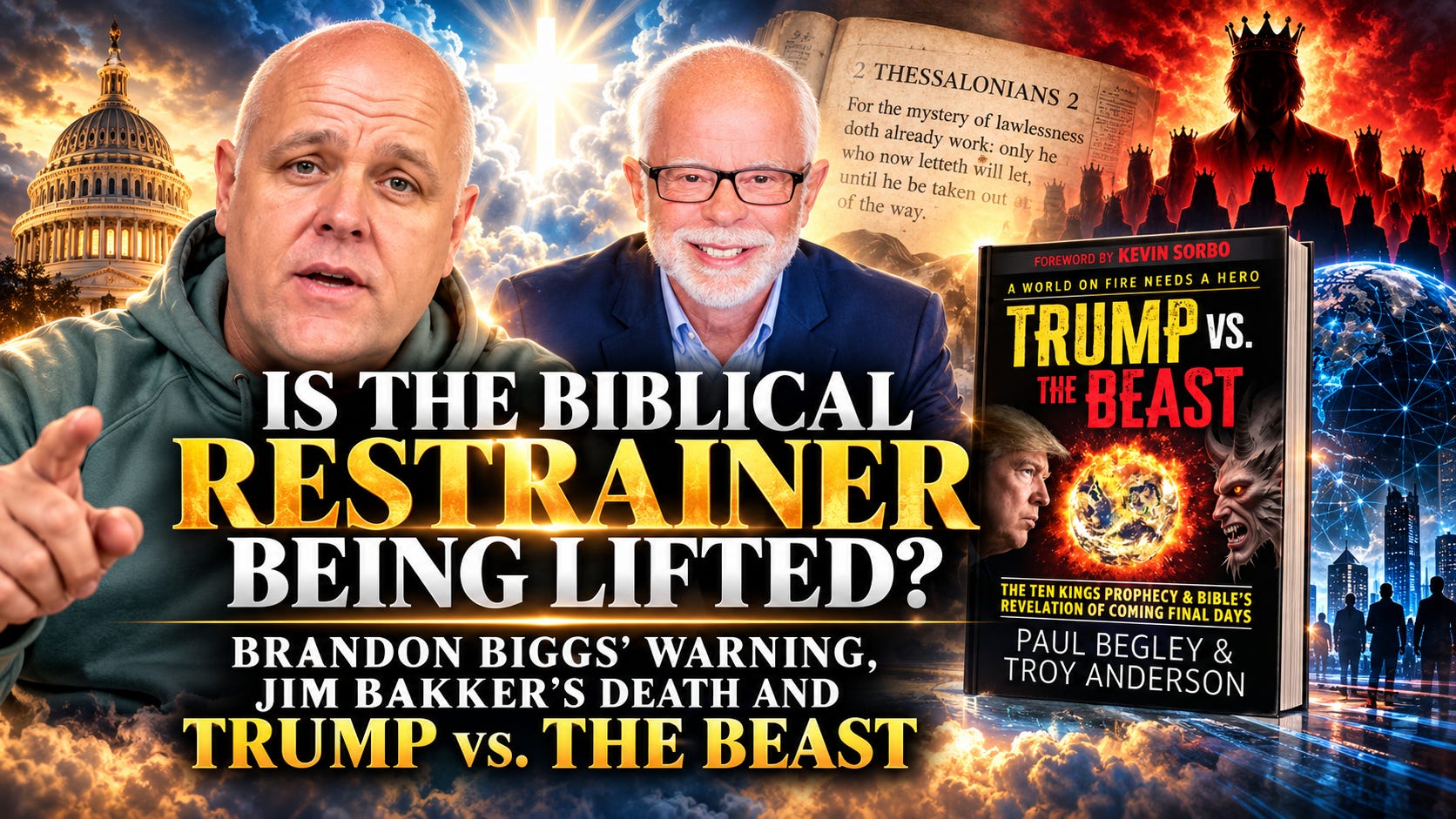
Following Brandon Biggs’ reported warning about Jim Bakker and the biblical restrainer, Revelation Watchers cofounders Pastor Paul Begley and Troy Anderson examine the mysterious prophecy of 2 Thessalonians 2, the rise of the Antichrist and the extraordinary timing of their new book’s release.

🎉📖Discover Pastor Paul Begley and Troy Anderson’s Inspiring Book Collection🎉📖
Revelation Watchers is a reader-supported publication. If you enjoy our articles and Pastor Paul Begley’s The Coming Apocalypse and Troy Anderson’s Revelation Watchers shows, consider becoming a paid subscriber. You will receive access to read in-depth articles, watch exclusive interviews, and partner in our mission to spread the Good News of Jesus Christ.
Could a prophetic warning reportedly delivered months before Jim Bakker’s death point to something far more consequential unfolding in the spiritual realm? And could the mysterious restrainer described by the apostle Paul nearly two thousand years ago hold important clues to the political, technological and spiritual transformations reshaping our world?
Those questions took on renewed significance this week following a remarkable sequence of events involving Christian prophetic commentator Brandon Biggs, internationally known pastor and broadcaster Paul Begley, and myself (investigative journalist and bestselling author Troy Anderson), the cofounders of Revelation Watchers.
In a recent broadcast, Biggs declared that the beast system will no longer be held back, adding that “the restraining force is being lifted.” His warning referred to one of the New Testament’s most debated prophetic mysteries: the unidentified force described in 2 Thessalonians 2 as restraining the revelation of the man of lawlessness, whom many Bible scholars associate with the Antichrist.
But another aspect of Biggs’ account has attracted considerable attention. According to Biggs, he contacted Pastor Begley in July 2026 to share three warnings he believed he had received from God, including a prediction concerning Jim Bakker’s death, a possible major pandemic outbreak in Russia, and the emergence of what Biggs described as the biblical beast system, the rise of the Antichrist.
On October 5, Bakker died at age 86. The following day, October 6, our new book, Trump vs. the Beast: The Ten Kings Prophecy and the Bible’s Revelation of Coming Final Days, was released by Humanix Books/Newsmax Media.
Then, during his October 8 broadcast, Pastor Begley welcomed me to discuss Biggs’ reported July warning, Bakker’s death and the larger biblical questions surrounding the restrainer, the Antichrist and the Ten Kings prophecy.
The timing was especially noteworthy because these topics are central to the investigation presented in our newly released book, which examines ancient biblical prophecy alongside artificial intelligence, transhumanism, digital financial systems and the changing geopolitical order.
Yet the convergence of events raises questions that require careful examination. Can Biggs’ reported advance prediction be documented? What did he actually tell Begley in July? And does the Bible provide a basis for concluding that the mysterious restrainer is being lifted?
For Revelation Watchers, these questions are central to our mission of examining biblical prophecy, current events and emerging technologies through Scripture, investigative journalism and faith. We believe extraordinary claims deserve serious attention, but they must also be evaluated against the available evidence and the biblical text.
The July Phone Call: What Did Brandon Biggs Tell Pastor Begley?
Nearly three months before Jim Bakker’s death, prophetic commentator Brandon Biggs says he contacted Pastor Paul Begley to share several warnings he believed he had received from God. According to Biggs, he wanted someone outside his immediate ministry circle to document what he was saying before the events occurred. Among the warnings was a statement concerning Bakker, the longtime Christian television broadcaster whose ministry had become closely associated with biblical prophecy and preparations for the last days.
During a subsequent broadcast, Biggs recalled telling Begley, “Jim Baker is going to go home,” using a familiar Christian expression referring to death and the hope of entering eternity with Christ. Biggs said he asked Begley to write down the warning, but the pastor reportedly responded, “I’ll do better. I’ll record it.” According to Biggs, Begley also placed the call on speakerphone so his wife could hear the conversation.
The reported exchange gained renewed attention following Bakker’s death on October 5, 2026. During his October 8 broadcast, Begley welcomed me on his show to discuss the July conversation, Bakker’s passing and the larger prophetic questions surrounding these events.
Bakker’s death marked the passing of a consequential and controversial figure in American evangelical broadcasting. Alongside his former wife, Tammy Faye Bakker, he helped build the PTL ministry into a major Christian television enterprise before his career became engulfed in scandal, including a federal conviction and imprisonment. Following his release, Bakker returned to broadcasting, increasingly emphasizing biblical prophecy, national emergencies and the importance of spiritual and practical preparation for future crises. His longstanding interest in end-times events added another dimension to the attention surrounding Biggs’ reported warning.
Yet the significance of Biggs’ account extends beyond Bakker’s death. According to his subsequent remarks, the July conversation also involved warnings about a potentially devastating disease outbreak and the emergence of what he described as the biblical beast system. Biggs later elaborated on prophetic impressions involving laboratory activity, biological manipulation and a possible public-health emergency that he believes could accelerate a transition away from physical currency toward increasingly comprehensive digital financial systems.
Biggs has also acknowledged uncertainty concerning the timing of his predictions. Discussing an earlier expectation involving 2027, he conceded, “It looks like I missed the timing of the year.”
Nevertheless, Biggs maintains that a profound spiritual shift is underway. His most consequential assertion is not merely that he anticipated Bakker’s death, but that the mysterious restraining force described by the apostle Paul is being lifted, potentially allowing the emergence of the Antichrist and the system of authority associated with him in biblical prophecy.
That claim brings us to the central theological question underlying the controversy: Who—or what—is the restrainer described in 2 Thessalonians 2, and what does the Bible actually reveal about its removal?
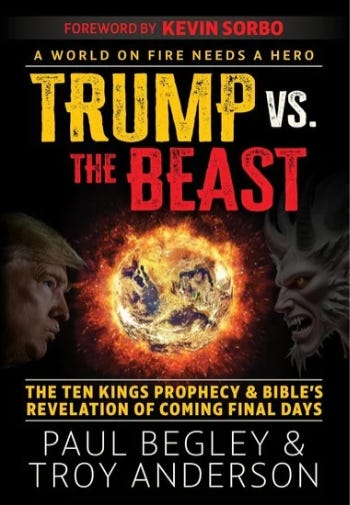
Get Trump vs. the Beast Today →
Now available in hardcover, e-book and audiobook.
Amazon | Barnes & Noble | | Books-A-Million
The Biblical Restrainer: What Does 2 Thessalonians 2 Reveal?
The apostle Paul’s second letter to the Thessalonians contains one of the New Testament’s most mysterious teachings concerning the events preceding the return of Jesus Christ. Writing to believers who were troubled by claims that the day of the Lord had already arrived, Paul warned them against deception and explained that certain developments would occur before the events he was describing.
In 2 Thessalonians 2:1–12, Paul refers to a rebellion, or falling away, and the revelation of the man of lawlessness, a figure characterized by extraordinary arrogance, opposition to God and claims to spiritual authority. Many evangelical prophecy scholars identify this figure with the Antichrist, although Christian traditions differ in how they interpret the passage and its relationship to other prophetic texts.
What I find especially intriguing about Paul’s teaching is his reference to a mysterious restraining influence already operating during his lifetime. Although the “mystery of lawlessness” was active, something—or someone—was preventing its fuller manifestation. Paul explained that the lawless one would be revealed only after this restraint was removed, and that his appearance would occur at the appointed time.
The passage does not, however, culminate in the triumph of evil. In verse 8, Paul declares that Jesus Christ will ultimately destroy the lawless one at His appearing. Whatever the identity of the restrainer, Paul’s larger message is that lawlessness remains subject to divine limits and that its apparent victory will be temporary.
The difficulty for modern readers is that Paul never explicitly identifies the restrainer in the surviving letter. He indicates that the Thessalonian believers already understood what he meant, apparently because he had previously instructed them on the subject. Without a complete record of those earlier conversations, interpreters have proposed several explanations.
Biblical prophecy meets today’s headlines.
In the #1 bestseller Revelation 911, Pastor Paul Begley and Troy Anderson explore how the ancient prophecies of Revelation intersect with today’s wars, global upheaval, emerging technologies and rapidly changing world events—calling believers to watch, pray and remain spiritually prepared.
Who—or What—is the Restrainer?
One of the most influential interpretations within contemporary evangelical prophecy teaching identifies the restrainer with the Holy Spirit working through the church. According to this understanding, the presence of Spirit-filled believers exercises a restraining influence against evil, and the removal of that particular ministry may be associated with the rapture, when Christians are gathered to Christ. Advocates of this view generally distinguish the removal of a restraining function from the idea that the Holy Spirit would cease to be present or active on earth.
Another longstanding interpretation associates the restrainer with civil government and lawful political authority. Some early Christian writers, including Tertullian, understood the Roman Empire as a force preserving order and restraining the emergence of a final period of lawlessness. Modern variations of this view emphasize the role of institutions, laws and legitimate governmental authority in preventing the complete breakdown of society.
Other interpreters believe the restrainer may be an angelic being acting under God’s direction. Some have suggested Michael the archangel, who appears in Daniel 10 and 12 as a heavenly figure associated with God’s people. Although that connection is possible within a broader prophetic framework, Paul does not explicitly identify Michael in 2 Thessalonians 2.
A fourth approach places primary emphasis on God’s sovereignty over the timing of the man of lawlessness. From this perspective, the restrainer may represent God’s providential control exercised through means that the text does not fully explain.
These interpretations reveal why the identity of the restrainer has remained debated for centuries. Biggs identifies the restrainer with the church, making his warning particularly significant within the futurist framework he embraces. Yet his statement raises several questions that I believe deserve closer examination.
Does he believe the church is approaching the rapture? Is he suggesting that its spiritual influence is weakening? Or does he mean that God is permitting a greater manifestation of lawlessness while Christians remain on earth?
Those possibilities carry different theological implications. More importantly, 2 Thessalonians does not identify Bakker’s death, a contemporary political event or any modern prophetic declaration as proof that the restrainer has been removed.
I believe Paul’s warning deserves serious study, particularly in a world experiencing profound changes in political authority, technology and culture. But studying the passage carefully also requires acknowledging what Scripture does not explicitly reveal.
What if Heaven is more real than we imagine?
I’ve Been to Heaven, an ECPA Bestseller and AWSA Memoir of the Year, tells the extraordinary true story of Steve Boyls’ near-death experience, his wife Kathy’s prayer that brought him back, and the powerful message of hope they believe God gave them to share with the world. Written with Troy Anderson, this inspiring testimony offers hope beyond this life—and a reminder of the power of faith, prayer and God’s love.
The Antichrist, the Ten Kings and the Rise of the Beast
One of the central reasons Pastor Begley and I wrote Trump vs. the Beast, the #1 “Hot New Release” in “Prophecies” on Amazon, was to investigate the relationship between ancient biblical prophecies and the extraordinary political, economic and technological transformations occurring in the modern world. Among the most intriguing passages are the visions of Daniel and Revelation concerning powerful kingdoms, a ruler who opposes God and a mysterious coalition of ten kings.
In Daniel 7, the prophet describes four beasts representing kingdoms, culminating in a fourth beast possessing ten horns. From among these horns emerges another, associated with arrogance, persecution and opposition to the people of God. Daniel 7:24 identifies the ten horns as ten kings arising from a kingdom, introducing imagery that has fascinated interpreters for centuries.
The Book of Revelation presents a striking parallel. In Revelation 17:12–13, the apostle John describes ten kings who receive authority for a limited period and share a common purpose in giving their power to the beast. Many futurist evangelical scholars understand these passages as describing a future coalition of rulers whose authority eventually becomes concentrated under a dominant figure associated with the Antichrist.
Other Christian traditions interpret substantial portions of these visions in relation to ancient empires, Roman imperial authority or recurring patterns of political oppression. The biblical texts themselves do not identify ten contemporary nations, corporations, international institutions or political leaders as the fulfillment of the prophecy.
Nevertheless, as I examine the modern geopolitical landscape, I find the imagery raises a question that has become increasingly relevant in an interconnected world: Could a future international crisis lead governments and powerful institutions to consolidate authority in ways that previous generations could scarcely have imagined?
Today’s political and economic landscape is characterized by networks of financial institutions, multinational corporations, military alliances and technological systems whose decisions can influence societies across national boundaries. A financial crisis in one region can rapidly affect markets around the world, while decisions involving monetary policy, international security or critical digital infrastructure can produce consequences for millions of people far removed from the institutions making them.
Artificial intelligence is adding another dimension to these developments by transforming how information is collected, analyzed and used to support decisions. The ability to coordinate vast amounts of data across financial, commercial and governmental systems creates opportunities for efficiency and innovation, but also raises concerns about concentrated power, accountability and individual freedom.
I do not believe these developments, by themselves, prove that the Ten Kings have emerged or that a present international organization represents the biblical beast. They do, however, provide a contemporary setting in which the questions raised by Daniel and Revelation deserve thoughtful consideration.
And perhaps nowhere is the intersection of prophecy and modern technology more striking than in Revelation 13, where political and religious allegiance becomes connected to the ability to participate in economic life.
What if history is hiding a code?
In the #1 bestseller The Trump Code, investigative journalist and six-time #1 Amazon and ECPA Bestsellers author Troy Anderson explores the extraordinary connections surrounding Nikola Tesla, time travel, the Trump family lineage and America’s future—following a trail of historical mysteries and remarkable coincidences that raises provocative questions about the past, present and what may lie ahead.
Revelation 13: Artificial Intelligence, Digital Money and Economic Control
Among the most unsettling passages in biblical prophecy is Revelation 13:16–17, where John describes a mark associated with the right hand or forehead and a system in which those without the mark are unable to buy or sell.
For centuries, Christians have debated whether this imagery anticipates a literal future mechanism of economic control, symbolizes allegiance to powers opposed to God or reflects the pressures experienced by early believers under Roman imperial rule. Within many futurist interpretations, the passage points toward a coming system in which political and religious loyalty becomes a condition for participating in ordinary commerce.
What makes this discussion especially compelling to me today is the remarkable speed at which emerging technologies are transforming identification, financial transactions, surveillance and institutional decision-making.
Artificial intelligence can analyze enormous quantities of information and support automated decisions affecting individuals and organizations. Biometric systems can authenticate identity through facial recognition, fingerprints and other physical characteristics. Digital payment networks can move money across borders almost instantaneously, while sophisticated surveillance technologies can collect and connect information at a scale that earlier generations could scarcely have imagined.
These developments offer significant benefits, including improved security, fraud prevention, medical innovation and greater efficiency. But their growing integration also creates vulnerabilities, particularly when powerful institutions exercise control without sufficient transparency, accountability or legal safeguards.
Consider a hypothetical system in which digital identification, financial accounts, personal information and automated enforcement mechanisms become closely interconnected. Under accountable institutions, such infrastructure might provide convenience and security. Under authoritarian control, similar capabilities could potentially be used to monitor dissent, restrict transactions or exclude individuals from essential services.
From my perspective, the question is not whether technology itself is inherently evil. It is whether societies can preserve human dignity, freedom of conscience and meaningful protections against abuses of power as technological systems become increasingly sophisticated.
Unlock the mystery of biblical prophecy.
The Babylon Code, a #1 bestseller from FaithWords/Hachette Book Group, uncovers startling connections between ancient prophecy, global events, and the forces shaping our future. Is the ancient mystery of Babylon unfolding before our eyes?
Brandon Biggs’ Warning About a Cashless Future
In his recent broadcast, Biggs described a possible sequence of events in which a major public-health emergency could discourage the use of physical currency and accelerate the adoption of electronic payments. He suggested that this transition might eventually extend from smartphones to wearable devices and potentially implanted identification or payment technologies.
Biggs connects that scenario with the mark of the beast described in Revelation 13. His interpretation reflects a concern shared by some contemporary prophecy commentators that the technological foundations for a future system of economic control could be developing long before its ultimate purpose becomes apparent.
Yet I believe important distinctions must be maintained. Electronic payment platforms, cryptocurrencies, commercial bank deposits and central bank digital currencies operate through different technological and institutional arrangements. The growth of digital finance does not necessarily require implanted devices, universal surveillance or the elimination of physical currency.
More importantly, Revelation associates the mark with the beast’s identity and a larger system of worship and allegiance. The passage does not explicitly identify smartphones, biometric identification, artificial intelligence or any existing digital currency as the mark of the beast.
I believe Christians should be particularly careful not to confuse technological possibility with demonstrated prophetic fulfillment. The fact that a technology could potentially be used to restrict financial transactions does not establish that it was created for the purpose described in Revelation.
At the same time, the growing dependence of modern societies on digital infrastructure raises legitimate concerns. Who controls access to essential financial services? What protections exist against arbitrary exclusion? Can individuals challenge automated decisions that affect their livelihoods? And how can governments and private institutions be held accountable when the technologies they administer become increasingly complex?
These are questions with profound implications regardless of one’s interpretation of biblical prophecy. They are also among the issues Pastor Begley and I explore in Trump vs. the Beast, particularly as artificial intelligence, digital identity and emerging financial technologies reshape the relationship between individuals and institutions.
Designated Disrupter: Trump and Other Unlikely Agents of Revival
Powerful forces. Hidden agents. A nation in transition.
Bestselling author and investigative journalist Troy Anderson explores the intersection of faith, politics and biblical prophecy—and how unlikely leaders and extraordinary events could help shape America’s spiritual future.
America at a Crossroads: The 2026 Midterm Elections
These questions have taken on added significance as the United States approaches the November 3, 2026, midterm elections, which will determine the composition of the next Congress and influence the remainder of President Donald Trump’s current term.
Debates over national sovereignty, religious liberty, financial regulation, surveillance and the role of artificial intelligence in government are becoming increasingly important as policymakers confront the opportunities and risks associated with rapidly advancing technologies.
Within some Christian prophecy circles, speculation has emerged about whether changes in political leadership could accelerate trends associated with centralized international authority. But as I examine these developments, I believe political forecasts must be distinguished from biblical predictions. Neither Daniel nor Revelation identifies the Democratic Party, the Republican Party or the outcome of the 2026 midterm elections as the event that brings the Antichrist to power.
A change in congressional control could have significant consequences for legislation, federal oversight and public policy. It would not, by itself, establish the fulfillment of an end-times prophecy. Likewise, international cooperation is not inherently equivalent to authoritarian global government.
For me, the more consequential questions concern the policies and institutions that will shape America’s future. How will emerging technologies affect constitutional freedoms, financial privacy and religious liberty? What safeguards will prevent abuses of surveillance and automated decision-making? And how can citizens evaluate these developments without allowing political loyalties to substitute for careful analysis?
Yet beyond the political questions lies an issue I believe is even more important: the spiritual condition of America and the possibility of renewed faith during a period of extraordinary uncertainty.
Billy Graham, Nineveh and the Hope of Spiritual Awakening
For myself, the biblical account of Nineveh holds particular significance. In 2013, I interviewed legendary evangelist Billy Graham about America’s spiritual condition and the lessons of Jonah’s warning to the ancient Assyrian city. That conversation helped shape my continuing investigation into biblical prophecy, national repentance and the possibility of spiritual awakening, themes that would later contribute to my involvement in The Return, the national gathering for prayer and repentance held on the National Mall in Washington, D.C., in September 2020.
The story of Nineveh, recorded in Jonah 3, offers a powerful reminder that prophetic warnings need not lead to despair. According to the Bible, God sent Jonah to warn the ancient city that judgment was approaching. Rather than dismissing the message, the people believed God, proclaimed a fast and turned toward repentance. Even the king humbled himself, calling upon the population to abandon evil and violence. When God saw their response, the biblical account tells us, He withheld the announced destruction, demonstrating the profound relationship between prophetic warning, human repentance and divine mercy.
For myself, the account has remained especially meaningful because it reveals a dimension of biblical prophecy that can easily be overshadowed by predictions of catastrophe. A warning about the future is not necessarily an announcement that hope has ended. It can also serve as an invitation to examine one’s life, turn away from wrongdoing and seek God. That understanding helped inform my involvement in The Return, which brought together Christian leaders and believers during a period of political division, the COVID-19 pandemic and widespread uncertainty about America’s future.
Six years later, Pastor Begley and I are returning to these themes through our “Trump vs. the Beast Save America Rescue Operation — 40 Days of Prayer, Fasting and Repentance.” The initiative reflects a conviction shared by us that Christians should respond to extraordinary events not merely by analyzing headlines or attempting to identify the fulfillment of prophecy, but by seeking God through prayer, humility, repentance and renewed commitment to biblical faith.
Even Brandon Biggs’ recent broadcast, despite its dramatic warnings, included an appeal for spiritual renewal. Biggs suggested that difficult circumstances could encourage people to return to church, take their faith more seriously and seek a deeper relationship with God. Whether his specific predictions will unfold remains uncertain, but the spiritual questions they raise extend far beyond any individual prophetic claim. They concern how believers should respond to fear, political division, technological disruption and the challenges of an increasingly uncertain world.
For Revelation Watchers, the lesson of Nineveh remains as relevant today as it was in the ancient world. Prophetic warnings should not merely provoke anxiety about what may happen tomorrow; they should encourage reflection on how we live today, how we treat others and whether our priorities reflect the faith we profess. Whatever uncertainties lie ahead, the biblical call to repentance, spiritual discernment and renewed faith offers a message of hope that transcends political circumstances and prophetic speculation.
Help Us Get This Message Into the Hands of More People
If you believe this message is important for this moment, order your copy today and share it with someone you care about. Together, we can help bring a message of biblical truth, discernment and hope to more people.
Why Trump vs. the Beast Matters Now
When we began researching and writing Trump vs. the Beast: The Ten Kings Prophecy and the Bible’s Revelation of Coming Final Days, our purpose was to investigate the extraordinary intersection of ancient biblical prophecy and the political, economic and technological changes transforming modern civilization. The mysterious Ten Kings, the Antichrist, artificial intelligence, transhumanism, digital financial systems and the future of America may appear to be separate subjects, but they raise interconnected questions about the nature of power, the preservation of freedom, the meaning of human identity and the responsibilities of faith in an increasingly complex world.
Our investigation draws upon Pastor Paul Begley’s decades of experience as a Christian pastor, broadcaster and commentator on biblical prophecy, together with my background in investigative journalism and bestselling nonfiction. Through our work as cofounders of Revelation Watchers, we have sought to bring these perspectives together, examining the relationship between Scripture, history, geopolitics and emerging technologies while encouraging readers to consider how ancient prophetic texts might inform their understanding of the modern world.
Featuring forewords by actor and filmmaker Kevin Sorbo and prophetic commentator Joseph Z, our newly released book invites readers to examine the biblical passages, consider the available evidence and reflect on the challenges facing Christians in an era of rapid technological advancement and geopolitical uncertainty. Its October 6 publication, coming just one day after Jim Bakker’s death and shortly before our October 8 discussion of Brandon Biggs’ reported warning, has brought renewed attention to many of the subjects explored in its pages. Yet the importance of this investigation does not depend on establishing that a particular prophetic timetable has begun or that any contemporary prediction has been conclusively fulfilled.
When we established Revelation Watchers, our vision was to create a platform dedicated to investigating biblical prophecy, breaking news, geopolitics, emerging technologies and extraordinary events shaping our world through Scripture, investigative journalism and faith. We recognize that Christians hold differing interpretations of the prophetic passages discussed in this article, and we believe those differences deserve thoughtful consideration. Not every political development, technological innovation or contemporary prophetic claim should automatically be regarded as a fulfillment of Scripture. At the same time, the remarkable changes taking place around us provide compelling reasons to examine the Bible’s prophetic teachings with renewed seriousness and discernment.
The apostle Paul’s instruction in 1 Thessalonians 5:20–21 offers an enduring foundation for this work, urging believers not to despise prophecies, but to test everything and hold fast to what is good. In an age when dramatic predictions and alarming headlines can spread around the world within minutes, that counsel is particularly relevant. We believe Christians can take biblical prophecy seriously while carefully evaluating extraordinary claims, distinguishing documented events from speculation and considering the implications of emerging technologies without assuming that every new development represents the fulfillment of Revelation.
Above all, we believe the Bible’s prophetic message is ultimately one of hope rather than fear. Daniel’s visions point toward God’s everlasting kingdom, Revelation portrays the Lamb overcoming the powers opposed to Him, and Paul’s account of the man of lawlessness culminates in the victory of Jesus Christ. Whatever uncertainties may lie ahead, our confidence does not rest in political leaders, technological systems or the predictions of any individual prophetic voice, but in the promises of Scripture and the sovereignty of God.
As we reflect on Brandon Biggs’ warning, Jim Bakker’s death, the extraordinary timing of our book’s release and the profound transformations reshaping our world, we believe the most important question is not simply whether we can recognize the signs of the times. It is whether we will respond to these developments with wisdom, courage, humility and faith. Through Trump vs. the Beast and our continuing work at Revelation Watchers, we invite readers to join us in examining the evidence, studying the Scriptures and seeking a deeper understanding of the times in which we live.
Watch the signs. Test everything. Hold fast to the truth.
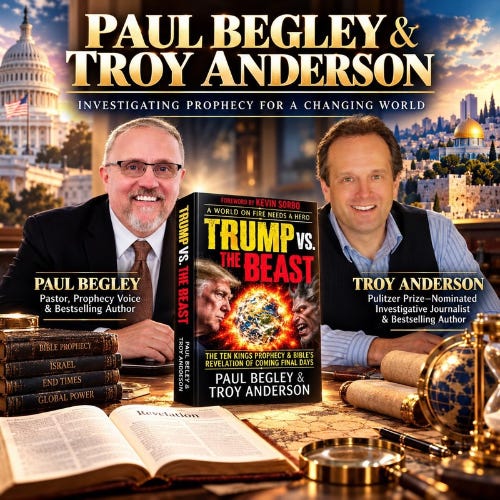
Discover Trump vs. the Beast
The Ten Kings Prophecy and the Bible’s Revelation of Coming Final Days
By Pastor Paul Begley and Troy Anderson | Published by Humanix Books/Newsmax Media | Released October 6, 2026
What might ancient biblical prophecies reveal about the extraordinary political, technological and spiritual transformations reshaping our world?
In our new book, Trump vs. the Beast, Pastor Paul Begley and I examine the mysterious Ten Kings, the Antichrist, artificial intelligence, transhumanism, emerging systems of global power and the future of America through the lens of Scripture, history and contemporary investigation.
Featuring forewords by actor and filmmaker Kevin Sorbo and prophetic commentator Joseph Z, our book explores the profound questions facing Christians in an increasingly interconnected world.
Available now in hardcover, e-book and audiobook.
Get Your Copy of Trump vs. the Beast on Amazon →
Watch the Interviews and Explore the Original Sources
We encourage readers to watch the original broadcasts, examine the statements in context and consider the biblical passages discussed throughout this investigation.
1. Pastor Paul Begley and Troy Anderson: October 8, 2026
During his October 8 broadcast, Pastor Paul Begley welcomed his Revelation Watchers cofounder and Trump vs. the Beast coauthor Troy Anderson for an in-depth discussion of Brandon Biggs’ reported July warning concerning Jim Bakker, the biblical restrainer described in 2 Thessalonians 2, and the prophetic questions explored in their newly released book.
Relevant segment: Approximately 23:50–51:10.
Watch Pastor Begley and Troy Anderson’s Discussion →
2. Brandon Biggs: The Biblical Restrainer and the Reported July Warning
In his broadcast, prophetic commentator Brandon Biggs discusses his belief that the restraining force described in 2 Thessalonians 2 is being lifted. He also recounts his reported July 2026 telephone conversation with Pastor Begley concerning Jim Bakker and shares additional warnings about events he believes may precede the emergence of the biblical beast system.
Key segments: Approximately 18:38–19:27 (the biblical restrainer) and 21:12–22:16 (the reported July telephone conversation).
Watch Brandon Biggs’ Original Broadcast →
Biblical Passages for Further Study
2 Thessalonians 2:1–12 — The restrainer and the man of lawlessness.
Daniel 7 — The four kingdoms, ten horns and little horn.
Revelation 13 — The beast, allegiance and restrictions on buying and selling.
Revelation 17:12–14 — The Ten Kings and their relationship to the beast.
Jonah 3 — Nineveh’s repentance and God’s mercy.
1 Thessalonians 5:20–21 — Testing prophetic claims and holding fast to what is good.

YOUR STORY DESERVES TO BE TOLD
Do you have a story, message, testimony, or book idea you believe could impact others? Inspire Literary Group helps aspiring and established authors develop compelling books through ghostwriting, editing, book proposal development, publishing guidance, and author support.
Books Change Lives. Yours Could Be Next.
EXPLORE INSPIRE LITERARY GROUP → InspireLiterary.com
Revelation Watchers investigates biblical prophecy, breaking news, geopolitics, emerging technologies and extraordinary events shaping our world through Scripture, investigative journalism and faith.
Editorial note: Prophetic statements discussed in this article are attributed to their respective speakers. Reported predictions, theological interpretations and allegations about future events should not be confused with independently verified facts or confirmed fulfillments of biblical prophecy.