

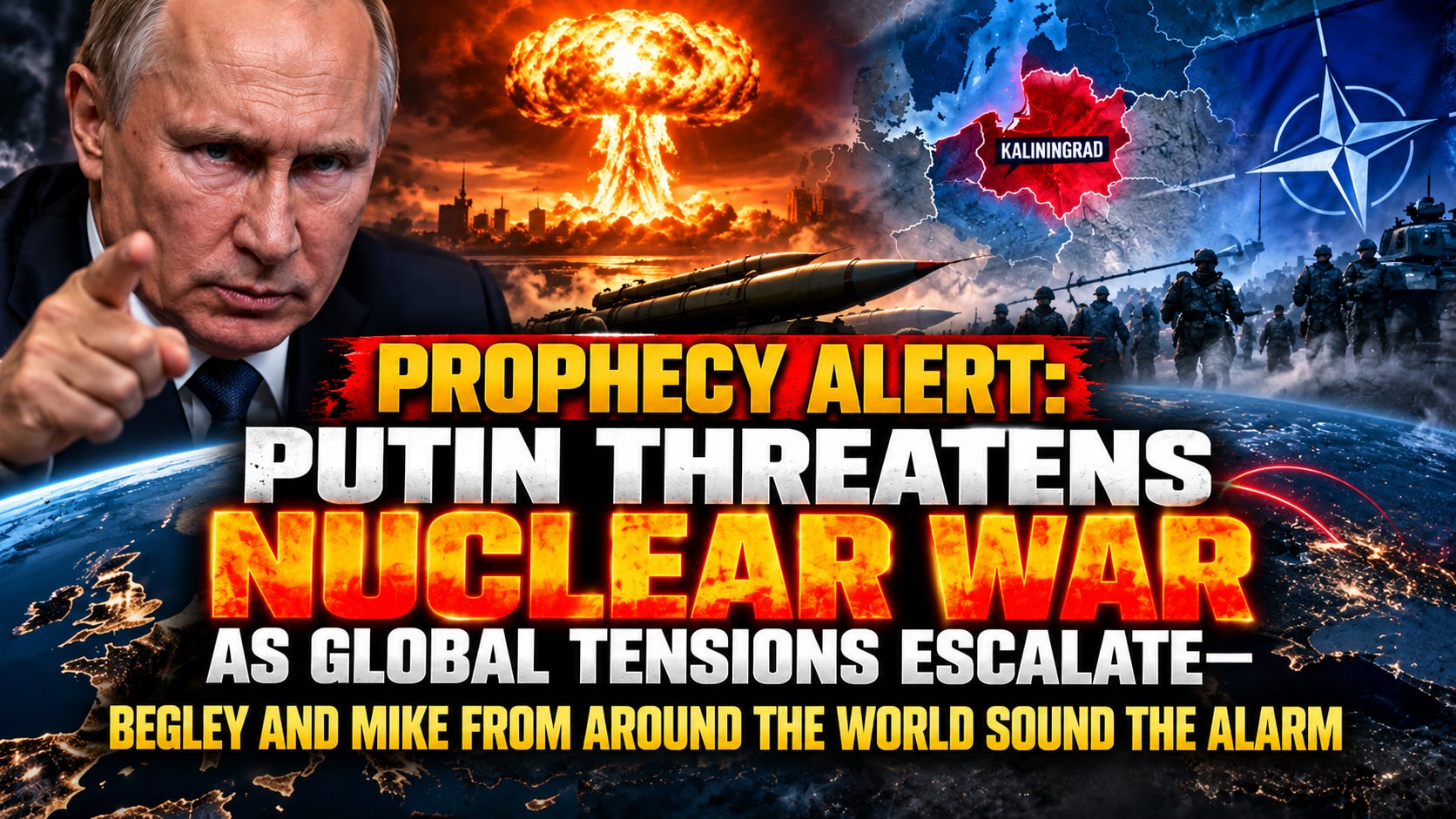
In their latest Thursday broadcast, Pastor Paul Begley and Mike From Around the World examine Putin’s nuclear warning, rising Russia-NATO tensions and the growing role of artificial intelligence in modern warfare—all through the lens of biblical prophecy.

🎉📖Discover Pastor Paul Begley and Troy Anderson’s Inspiring Book Collection🎉📖
Revelation Watchers is a reader-supported publication. If you enjoy our articles and Pastor Paul Begley’s show and Troy Anderson’s Revelation Watchers show, consider becoming a paid subscriber. You will receive access to read in-depth articles, watch exclusive interviews, and partner in our mission to spread the Good News of Jesus Christ.
The nuclear shadow hanging over Europe grew darker this week as Russian President Vladimir Putin issued another stark warning to the West, raising fears that the confrontation between Russia and NATO could enter an even more dangerous phase. During their latest Thursday broadcast, Revelation Watchers co-founder Pastor Paul Begley and geopolitical commentator Mike From Around the World examined the warning against the backdrop of the continuing war in Ukraine, accelerating military technology and the growing role of artificial intelligence on the modern battlefield.
Begley repeatedly returned to Putin’s declaration that the world is passing through a “dangerous moment,” focusing particular attention on Kaliningrad, Russia’s strategically important Baltic exclave situated between NATO members Poland and Lithuania. With tensions already elevated along NATO’s eastern flank, Begley raised the possibility that a confrontation involving Kaliningrad could become a flashpoint for a much wider conflict—and asked whether the mounting pressure surrounding Russia could one day intersect with the larger geopolitical events described by the biblical prophets.
“This is a dangerous time,” Begley told his audience before bringing Mike From Around the World into the conversation. His concern was rooted not merely in speculation circulating online, but in Putin’s own increasingly forceful warnings about what Russia considers a direct threat to its territory.
Speaking at the Valdai Forum on October 1, Putin warned Western nations against further escalation and specifically addressed the possibility of an attack on Russian territory, including Kaliningrad. Moscow has also warned NATO that an attempt to isolate the territory could provoke a response involving Russia’s full military arsenal, including nuclear weapons. NATO, for its part, has rejected claims that it poses a threat to Kaliningrad, described its activities in the region as defensive and condemned Russia’s nuclear rhetoric.
For students of Bible prophecy, however, the significance of this moment extends beyond a single statement from the Kremlin or even the immediate confrontation between Russia and NATO. The larger question is whether several developments once considered separately—wars and rumors of wars, nuclear confrontation, artificial intelligence, autonomous weapons, expanding digital surveillance and increasingly sophisticated systems of economic and technological control—are beginning to converge in ways that deserve closer attention.
That does not mean every geopolitical crisis should be declared a fulfillment of prophecy. It does mean that Christians have reason to watch these developments carefully, examine them in light of Scripture and ask how believers should respond to a world changing with extraordinary speed.
Putin Draws a Nuclear Red Line Around Kaliningrad
Kaliningrad may be relatively small, but its strategic importance far exceeds its size. Situated on the Baltic Sea between NATO members Poland and Lithuania, the Russian exclave is geographically separated from mainland Russia and heavily militarized, hosting significant Russian military assets, including nuclear-capable Iskander missile systems. Moscow has claimed that NATO could attempt to isolate or blockade the territory, while NATO has rejected those allegations, insisting that its activities in the region are defensive and pose no threat to Russian territory.
Against that already tense backdrop, Putin sharpened his warning on Thursday. Although he said Russia had no intention of attacking European countries and wanted peaceful coexistence, he made clear that Moscow considers Kaliningrad Russian territory that it is prepared to defend with the full range of weapons at its disposal. If Russia were subjected to a direct attack—including an attack on Kaliningrad—the question of employing “all the weapons” available to Moscow would, he said, immediately arise.
The danger in such a confrontation lies not simply in what Moscow or NATO says it intends to do, but in how each side interprets the actions of the other. Military exercises intended as deterrence can be perceived as preparations for attack; defensive deployments can provoke counter-deployments; increasingly forceful rhetoric can narrow the space for diplomacy. As forces operate in closer proximity and decision-making time shrinks, the risk grows that a misunderstanding, miscalculation or unintended escalation could set events in motion that neither side originally sought.
Putin himself acknowledged that danger at the Valdai Forum, warning that an escalating cycle of increasingly severe retaliatory measures could eventually reach what he described as a “fatal point of no return.” NATO Secretary General Mark Rutte, meanwhile, said the alliance sees no imminent threat to NATO territory and responded to Moscow’s warning by reiterating NATO’s defensive posture and rejecting nuclear threats.
It was this combination of nuclear rhetoric, strategic vulnerability and the possibility of miscalculation that caught Begley’s attention. Throughout Thursday’s broadcast, he returned to Putin’s warning that the world is passing through a dangerous moment and questioned why Kaliningrad had suddenly become the focus of such explicit language from Moscow.
To explore what might lie behind the warning—and where the confrontation could lead—Begley turned to his longtime Thursday-night guest, Mike From Around the World.
Ancient prophecy. Global power. A world in transformation.
In Trump vs. the Beast, the #1 “Hot New Release” in “Prophecies,” Pastor Paul Begley and Troy Anderson investigate the Ten Kings prophecy, artificial intelligence, the rise of technocratic systems, and the biblical warnings surrounding the coming final days. Releases October 6, 2026 from Humanix Books/Newsmax Media.
Mike From Around the World: “Putin Is Quite Serious”
When Mike From Around the World joined the broadcast, Begley went directly to the growing confrontation over Kaliningrad. After recounting Putin’s warning, he asked Mike how seriously the Russian president’s words should be taken and what might be driving Moscow to draw such a sharp line around the strategically important territory.
Mike’s answer was unequivocal: “Putin is quite serious.”
In Mike’s assessment, the Russian leader recognizes not only the conventional military pressure surrounding his country, but also a technological transformation that is rapidly changing the nature of warfare. From there, the conversation moved beyond traditional calculations of troops, missiles and territorial defenses to a force that Mike believes will increasingly shape the outcome of future conflicts: artificial intelligence.
“We’re talking about government AI,” Mike told Begley. “We’re talking about AI tied to weaponry.”
Mike argued that AI is becoming deeply integrated into military command-and-control systems and described the war in Ukraine as an important testing ground for increasingly sophisticated weapons, drones and automated battlefield technologies. In his view, the significance of this transformation goes far beyond individual weapons systems; it points toward a future in which vast networks of sensors, aircraft, missiles, drones and other military assets could increasingly be coordinated with the assistance of artificial intelligence.
Some of Mike’s more specific assertions during the broadcast represent his own geopolitical and technological analysis and should be understood in that context. Yet the broader transformation he described is already visible. Militaries around the world are investing heavily in artificial intelligence, autonomous systems and unmanned warfare as they seek to process battlefield information more quickly, identify threats more accurately and shorten the time between detection and response.
The U.S. military’s January 2026 artificial-intelligence strategy calls for accelerating AI integration across warfighting, intelligence and other military missions, including AI-enabled battle management, decision support and what the strategy describes as “kill chain execution.” At the same time, the war in Ukraine has become an extraordinary proving ground for drone warfare and other unmanned technologies, with American military planners studying lessons from Ukrainian forces and incorporating them into U.S. training and battlefield doctrine.
What makes this transformation so consequential is not simply the arrival of smarter drones or more sophisticated weapons. As artificial intelligence becomes more deeply embedded in military decision-making, the time available for human beings to interpret threats and decide how to respond may continue to shrink. In a confrontation involving NATO and a nuclear-armed Russia, that raises a sobering question that reaches far beyond the war in Ukraine: What happens when the speed of warfare begins to exceed the speed of human judgment?
Biblical prophecy meets today’s headlines.
In the #1 bestseller Revelation 911, Pastor Paul Begley and Troy Anderson explore how the ancient prophecies of Revelation intersect with today’s wars, global upheaval, emerging technologies and rapidly changing world events—calling believers to watch, pray and remain spiritually prepared.
When Machines Enter the Kill Chain
For generations, one of the safeguards against the nightmare of nuclear war has been the presence of human beings at critical points in the decision-making process. Presidents, military commanders and officers must evaluate intelligence, communicate with one another, assess whether a perceived threat is genuine and ultimately decide how—or whether—to respond. Artificial intelligence has the potential to alter that equation by dramatically accelerating the speed at which information is gathered, interpreted and acted upon.
AI systems can process enormous quantities of data far faster than human analysts, drawing information from satellites, radar, battlefield sensors and other sources to identify potential targets, recognize patterns and help commanders make decisions. Used responsibly, such capabilities could improve situational awareness, strengthen defenses and even save lives. Yet the same speed that makes artificial intelligence so valuable in warfare could also compress the amount of time available for human deliberation during a rapidly developing crisis.
Consider what could happen in a future confrontation in which autonomous drones, AI-assisted targeting systems, missile defenses, cyberwarfare platforms and conventional or nuclear forces are operating simultaneously. A computer system might identify what appears to be an incoming threat while another analyzes possible responses and still another detects military movements that its algorithms interpret as hostile. The central concern is not necessarily the science-fiction scenario of a machine independently “deciding” to start World War III, but something more plausible: governments becoming increasingly dependent upon automated systems that operate so rapidly that human decision-makers have less time to determine whether the information before them is accurate, incomplete—or dangerously wrong.
That possibility becomes especially consequential when nuclear-armed powers are involved. A false warning, misidentified target, cyberattack, corrupted data stream or incorrect algorithmic assessment could place extraordinary pressure on leaders who may have only minutes to determine whether an attack is actually underway. The faster warfare becomes, the more important the question of meaningful human judgment becomes, particularly when a mistaken decision could produce consequences that cannot be reversed.
For students of Bible prophecy, these developments also raise questions that extend beyond military strategy. Scripture describes a future world in which extraordinary political power, economic control and a mysterious “image” capable of speaking become intertwined in Revelation 13. Begley turned directly to that chapter during Thursday’s broadcast, asking his audience to consider what ancient prophecy might look like in an age when machines can already see, speak, analyze human behavior and increasingly participate in decisions once reserved exclusively for people.

What if Heaven is more real than we imagine?
I’ve Been to Heaven, an ECPA Bestseller and AWSA Memoir of the Year, tells the extraordinary true story of Steve Boyls’ near-death experience, his wife Kathy’s prayer that brought him back, and the powerful message of hope they believe God gave them to share with the world. Written with Troy Anderson, this inspiring testimony offers hope beyond this life—and a reminder of the power of faith, prayer and God’s love.
Begley Turns to Revelation 13
Before Mike joined the broadcast, Begley opened his Bible to one of Scripture’s most mysterious and sobering prophetic chapters: Revelation 13. The passage describes the rise of the Beast, followed by a second beast commonly associated in Christian eschatology with the False Prophet, who exercises extraordinary authority, causes an image of the Beast to speak and ultimately enforces a system in which the ability to participate in commerce becomes conditional upon receiving the mark of the Beast.
Begley read from the passage describing the moment when “no man might buy or sell” without the mark, then focused on another remarkable detail: the image of the Beast is given the ability to speak. Looking at that prophecy through the technological landscape emerging today, Begley suggested that artificial intelligence offers a striking modern parallel to something that would have been almost impossible for previous generations to envision—a created image capable of communicating, interacting and exercising influence.
His interpretation raises an intriguing question, but also one that requires biblical caution. Revelation does not identify artificial intelligence as the Mark of the Beast, nor does Scripture specifically name facial recognition, digital currencies, biometric identification, algorithms, smartphones or computer networks as prophetic fulfillments. Christians have debated the meaning and eventual fulfillment of Revelation 13 for nearly two thousand years, and technological developments should not be forced into biblical passages simply because they appear new or unsettling.
What has changed, however, is the technological environment in which these ancient prophecies are being read. Humanity is now developing interconnected systems capable of identifying people on a vast scale, authenticating identity, analyzing behavior, monitoring financial transactions and potentially determining who may gain access to particular services or economic networks. Artificial intelligence adds another dimension by allowing machines to recognize images, generate speech, communicate with people and make increasingly sophisticated assessments based on enormous quantities of data.
None of this proves that today’s technologies constitute the system described in Revelation 13. It does, however, make aspects of the prophecy technologically conceivable in a way that would have been difficult for earlier generations to imagine. A future system capable of linking identity, commerce, surveillance and centralized authority no longer belongs solely to the realm of speculation; many of its underlying technological components already exist, even though how—or whether—they might ultimately relate to biblical prophecy remains an open question.
For that reason, prophecy should produce discernment rather than sensationalism. The task of the watchman is not to force every technological breakthrough into a prophetic timetable, but neither is it to ignore developments that could reshape the relationship between governments, technology, money and individual freedom. Revelation calls believers to remain spiritually alert, and the extraordinary transformation now taking place around us gives new urgency to that ancient command.
Discover Trump vs. the Beast
What do ancient biblical prophecies have to say about the extraordinary changes unfolding in our world? Trump vs. the Beast explores the mysterious Ten Kings of Revelation, the Antichrist and False Prophet, artificial intelligence, global power, digital systems and the spiritual questions surrounding our rapidly changing world.
Explore the book, endorsements and preorder options: Explore Trump vs. the Beast →
Trump vs. the Beast: Investigating the Convergence
The convergence of prophecy, technology and geopolitical upheaval explored during Thursday’s broadcast lies at the heart of the investigation Pastor Begley and I undertook in our new book, Trump vs. the Beast: The Ten Kings Prophecy and the Bible’s Revelation of Coming Final Days. Throughout our research, we returned to a fundamental question: What happens when ancient biblical prophecies about global power and control begin to intersect with artificial intelligence, digital surveillance, geopolitical realignment and technologies capable of influencing human activity on a scale previous generations could scarcely have imagined?
In Trump vs. the Beast, we investigate the mysterious Ten Kings prophecy, biblical descriptions of the rise of the Antichrist, the prophetic significance of Israel and Jerusalem, the extraordinary expansion of artificial intelligence and the emergence of increasingly sophisticated technocratic systems. We also examine the struggle over national sovereignty and the possibility that technologies originally developed for convenience, security, commerce or defense could eventually become components of much larger systems of political and economic control.
The point is not that Christians should fear technology or regard every technological advance as evidence of prophetic fulfillment. Technology itself is a tool, capable of extraordinary good as well as profound misuse. The more consequential question is who controls these systems, how they are used and what happens when immense technological power becomes concentrated in institutions capable of influencing identity, information, commerce, surveillance and human freedom.
Seen from that perspective, Thursday’s discussion about Putin and artificial intelligence is not disconnected from the broader questions we examine in the book. Russia’s nuclear confrontation with the West, the transformation of warfare in Ukraine, the military application of artificial intelligence, the expansion of digital surveillance and the continuing evolution of money and financial systems each have their own political, economic and technological explanations. Yet taken together, they illustrate how rapidly systems of military, governmental, technological and economic power are changing—and how increasingly interconnected they are becoming.
Bible prophecy invites believers to look beyond any single headline and consider the larger trajectory of history. The question is not whether every development unfolding today fulfills a particular verse of Scripture, but whether technologies and institutions now emerging separately could eventually converge into systems possessing capabilities that earlier generations would have found almost impossible to imagine. That possibility is one of the central questions at the heart of Trump vs. the Beast—and one reason the events unfolding around us deserve careful, prayerful attention.

What if history is hiding a code?
In the #1 bestseller The Trump Code, investigative journalist Troy Anderson explores the extraordinary connections surrounding Nikola Tesla, time travel, the Trump family lineage and America’s future—following a trail of historical mysteries and remarkable coincidences that raises provocative questions about the past, present and what may lie ahead.
Could This Be the “Hook in the Jaw”?
As Begley considered the mounting pressure surrounding Russia and the possibility of a wider confrontation with NATO, he raised one of the broadcast’s most provocative prophetic questions: Could circumstances such as these eventually relate to the mysterious “hook” described in Ezekiel 38?
“Is this the hook in the jaw?” Begley asked, not as a declaration that Ezekiel’s prophecy was being fulfilled, but as a question about where the growing confrontation could ultimately lead.
Ezekiel 38 describes Gog being drawn into a massive future conflict involving Israel and a coalition of nations. The passage has generated centuries of debate among biblical scholars and prophecy teachers, particularly over the identity of Gog and Magog, the nations involved and the timing of the battle. Many modern prophecy interpreters have associated elements of Ezekiel’s coalition with Russia and surrounding nations, while other scholars dispute that identification or understand the passage differently.
For that reason, it would be premature to declare the present confrontation over Kaliningrad—or the broader war involving Russia and Ukraine—to be the fulfillment of Ezekiel 38. Begley did not make that claim during the broadcast. Instead, he raised the possibility that growing geopolitical pressure on Russia could be worth watching in light of Ezekiel’s striking description of Gog being drawn into a future conflict.
That distinction is essential to responsible prophecy analysis. Biblical prophecy calls believers to remain watchful, but watchfulness does not require forcing every international crisis into a predetermined prophetic timeline. Current events should be examined alongside Scripture with humility, recognizing both the remarkable parallels that may emerge and the limits of what can responsibly be concluded from them.
Even apart from questions about Ezekiel 38, the geopolitical developments themselves warrant serious attention. Russia remains one of the world’s major nuclear powers; the war in Ukraine continues to shape European security; NATO and Russian military forces operate within an increasingly tense strategic environment; and Moscow has publicly warned that a direct attack on Russian territory, including Kaliningrad, could raise the possibility of employing the full range of weapons available to it.
Whether or not today’s events ultimately prove connected to Ezekiel’s prophecy, they underscore the reality that relationships among Russia, Europe, the Middle East and Israel can shift with extraordinary speed. For students of Bible prophecy, the appropriate response is neither to declare fulfillment prematurely nor to ignore developments that resemble themes Scripture tells believers to watch. It is to remain attentive, prayerful and anchored in the biblical text as history continues to unfold.
“Wars and Rumours of Wars”
Against the backdrop of nuclear threats, continuing warfare and geopolitical uncertainty, the words of Jesus in Matthew 24 carry particular weight. Speaking to His disciples about events surrounding the end of the age, Christ warned that they would hear of “wars and rumours of wars,” but He immediately followed that warning with an instruction Christians should remember just as clearly: “see that ye be not troubled” (Matthew 24:6).
That second part of Christ’s warning is especially important in an age when images of war can circle the globe within seconds and every new crisis can arrive instantly on our phones. Jesus did not tell His followers to ignore world events, but neither did He instruct them to live in fear of them. His words call believers to remain spiritually awake while refusing to allow turmoil, speculation or uncertainty to overwhelm their faith.
That perspective should shape how Christians approach the developments discussed during Thursday’s broadcast. Putin’s nuclear warnings deserve serious attention, but they should not produce panic. The rapid advance of artificial intelligence deserves careful examination, but Christians need not regard every new technology as inherently evil. Revelation 13 deserves rigorous study, but every new financial or identification system should not automatically be declared the Mark of the Beast. In the same way, wars, alliances and geopolitical realignments can be examined for their possible prophetic significance without attempting to set dates or claim certainty where Scripture does not provide it.
Biblical prophecy was never intended merely to satisfy curiosity about the future. It calls believers to faithfulness in the present—to discern the times, remain spiritually prepared, proclaim the Gospel and place their confidence in God even when the world appears increasingly unstable. The prophetic passages of Scripture remind us that history is not moving randomly or beyond God’s knowledge; they point toward the ultimate fulfillment of His purposes and the return of Jesus Christ.
For that reason, watching and trusting are not opposites. Christians can pay close attention to what is happening in Russia, Ukraine, Israel, the Middle East and throughout the world while remaining anchored in the words Christ gave His disciples nearly two thousand years ago. “See that ye be not troubled” is not a call to indifference. It is a call to discernment without fear, vigilance without panic and spiritual readiness grounded in faith.
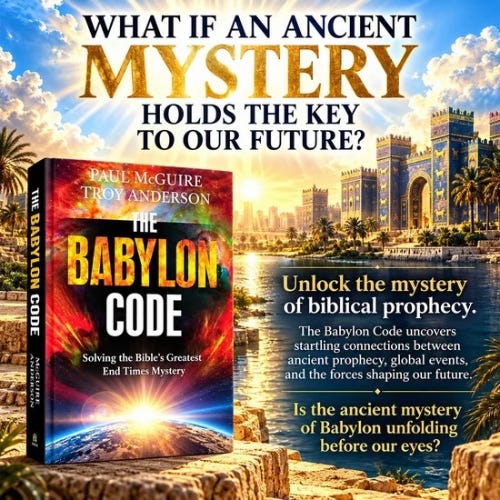
Unlock the mystery of biblical prophecy.
The Babylon Code, a #1 bestseller from FaithWords/Hachette Book Group, uncovers startling connections between ancient prophecy, global events, and the forces shaping our future. Is the ancient mystery of Babylon unfolding before our eyes?
A Dangerous Prophetic Hour
What made Thursday’s conversation particularly striking was not any single prediction or headline, but the convergence of developments that only a generation ago might have seemed largely unrelated. Nuclear confrontation, the war in Ukraine, rising tensions between Russia and NATO, artificial intelligence and autonomous warfare are unfolding alongside profound technological and geopolitical changes that are reshaping how nations exercise power and how future conflicts may be fought.
None of this proves that the final events described in Revelation are imminent, nor does it provide a timetable for Christ’s return. Jesus warned His followers about deception and repeatedly emphasized watchfulness and readiness rather than date-setting. Yet caution should not become complacency. The extraordinary pace of change surrounding warfare, technology, global power and economic systems gives believers reason to remain attentive to developments that previous generations could scarcely have imagined.
That is ultimately what made Begley and Mike From Around the World’s Thursday discussion so consequential. The question is not whether every headline fulfills a particular prophecy, but whether the world is developing in directions that make the warnings of Scripture increasingly important to understand. Whatever may come next, the biblical response remains the same: watch carefully, test what we see against Scripture and remain spiritually prepared.
Watch, Pray and Be Ready
If these developments are indeed signs of a world entering a more dangerous and consequential period, the question for believers is not simply what will happen next, but how we should live in the midst of it. Scripture repeatedly gives us the answer: watch, pray, exercise discernment and remain spiritually ready.
That calling leaves little room for either fear or obsession. Christians are not called to spend their lives attempting to identify the Antichrist, interpreting every political development as prophetic fulfillment or allowing partisan anger and political division to eclipse the Gospel. Neither should our fascination with prophecy become so consuming that we lose sight of why God revealed these things in the first place. Biblical prophecy is ultimately intended to awaken us—to remind us of the urgency of the hour, the certainty of Christ’s promises and the mission He has entrusted to His Church.
That mission remains before us regardless of what happens in Moscow, Washington, Jerusalem or Brussels. There are people who need to hear the Gospel, prodigals who need to come home, families that need prayer, hurting people who need hope and a generation searching for truth in a world increasingly filled with confusion. If the prophetic clock is indeed advancing, the appropriate response of the Church is not retreat, but greater faithfulness.
The geopolitical landscape may continue to grow more dangerous. Russia and NATO may remain locked in confrontation, nuclear rhetoric may intensify, artificial intelligence may transform warfare faster than governments can fully understand or regulate it, and digital systems may become increasingly interconnected and powerful. Yet none of these developments alters the central message or ultimate hope of Scripture: Jesus Christ is Lord, and history does not end with the triumph of war, technology, political power or the Antichrist. It ends with the triumph and return of Jesus Christ.
That is why we watch without surrendering to fear, pray without ceasing and remain ready without attempting to predict the day or hour. Our confidence does not rest in governments, military alliances, technological systems or human leaders, but in the One who declared Himself the Alpha and the Omega, the beginning and the end.
Until that day, Revelation Watchers will continue to watch the signs, examine the evidence and test what we see against the Word of God—not simply so that we may understand prophecy, but so that people may come to know the One to whom all prophecy ultimately points: Jesus Christ.
A Prayer for Peace, Discernment and Revival
Heavenly Father,
We come before You in the mighty name of Jesus Christ, placing our trust in You at a time when nations are shaking, wars continue, nuclear threats are being spoken and powerful new technologies are advancing at a pace the world is still struggling to understand.
Lord, we ask You to restrain the forces of war and bring wisdom to the leaders of Russia, Ukraine, the United States, NATO nations, Israel and nations throughout the world. Guard them against pride, deception and catastrophic miscalculation. Frustrate plans that would lead to unnecessary bloodshed, open doors for peace where peace is possible, and protect the innocent men, women and children whose lives are caught in the midst of conflict.
Father, give Your Church wisdom and discernment in this prophetic hour. Keep us from becoming spiritually asleep to the signs of the times, but also protect us from fear, confusion and deception. Teach us to watch with wisdom, pray with faith and courageously stand upon the truth of Your Word, remembering that our hope is found not in the circumstances around us, but in Jesus Christ.
As artificial intelligence, autonomous weapons, surveillance systems and other powerful technologies continue to advance, give those who develop and govern them wisdom and restraint. Protect humanity from their misuse, and help us preserve the dignity, freedom and value of every human life created in Your image.
Above all, Lord, we ask You to send revival. Pour out Your Spirit upon America, Israel and the nations of the world. Awaken Your Church, restore families, bring prodigals home and draw those who do not yet know Jesus Christ into a saving relationship with You. Raise up pastors, evangelists, intercessors, watchmen and faithful believers who will proclaim the Gospel with courage, compassion and love in a generation desperately searching for truth and hope.
When the world seems overwhelmed by darkness, remind us that darkness cannot overcome the light of Christ. Help us keep our eyes fixed upon Jesus, remain faithful to the mission You have given us and live each day with the expectation that Your purposes will ultimately prevail.
We place our trust not in governments or military power, not in technology or human wisdom, but in You—the King of kings and Lord of lords. Give us peace in the midst of uncertainty, courage in the face of fear and faithfulness as we watch and pray for the return of our Lord and Savior, Jesus Christ.
In the mighty name of Jesus Christ, we pray. Amen.
Watch the Full Broadcast
Watch Pastor Paul Begley’s complete Thursday broadcast with Mike From Around the World as they discuss Putin’s nuclear warning, the escalating tensions surrounding Russia and NATO, artificial intelligence and the rapidly changing landscape of modern warfare.
Breaking: “Putin Threatens The Nukes” | Pastor Paul Begley & Mike From Around the World | Watch the full Thursday broadcast on YouTube →
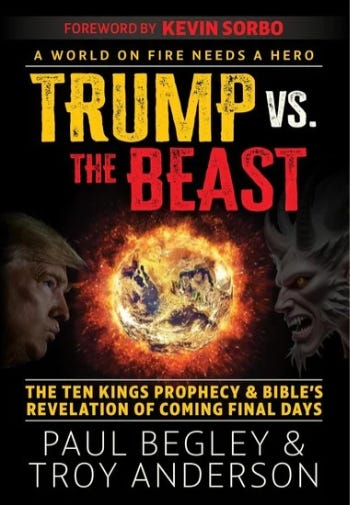
About Trump vs. the Beast
Trump vs. the Beast: The Ten Kings Prophecy and the Bible’s Revelation of Coming Final Days by Pastor Paul Begley and Troy Anderson releases October 6, 2026.
In this new investigative book, Begley and Anderson explore the mysterious Ten Kings prophecy, the rise of artificial intelligence and technocratic systems, the Antichrist, Israel’s prophetic significance and the accelerating convergence of biblical prophecy, global power and world events.
For readers seeking to go deeper into many of the prophetic questions explored in this article, Trump vs. the Beast examines how ancient biblical warnings may intersect with the extraordinary geopolitical and technological transformation unfolding in our time.
Explore Trump vs. the Beast on Troy Anderson’s official website →

YOUR STORY DESERVES TO BE TOLD
Do you have a story, message, testimony, or book idea you believe could impact others? Inspire Literary Group helps aspiring and established authors develop compelling books through ghostwriting, editing, book proposal development, publishing guidance, and author support.
Books Change Lives. Yours Could Be Next.
EXPLORE INSPIRE LITERARY GROUP → InspireLiterary.com
All you pre- tribbers have some explaining to do. Like how do you completely ignore the fact that Jesus tells us in Matthew 24 that He comes for us after the Lawless One appears. Not before.